
Stamford City Directory Shelf Map
Stamford has no single county shelf that gathers every name list. The verified Stamford city directory trail is split between the Stamford History Center's RG-15 material, Ferguson Library's Stamford Room, the Marcus Research Library, and an Internet Archive scan. Start with the Stamford collection that matches the year, then note whether the source is a page image, microfilm reel, catalog entry, or onsite manuscript. That distinction matters when a Stamford volume has not been digitized.
| Collection | Years | Where Held | Access |
|---|---|---|---|
| J. C. Benham, Directory of the Town of Stamford | 1872 | Stamford History Center RG-15 bibliography and Marcus Research Library | Onsite catalog and reading-room research |
| City of Stamford Directories | 1879-1916 | Stamford History Center RG-15 and Ferguson microfilm | History Center onsite; Ferguson Stamford Room |
| Stamford Ferguson city-directory microfilm | 1879-1966 | Ferguson Library Stamford Room | Library reference and microfilm access |
| Boyd's General Directory, Stamford section | 1881-82 | Internet Archive scan; printed Stamford section begins at page 33 | Free page images, with date metadata to check |
| Stamford House Register | 1865-1869 | Stamford History Center RG-15 and Marcus Research Library | Onsite historical research |
| General Index Land Records Stamford | 1641-1900 | Marcus Research Library | Onsite name and land-history bridge |
Later annual publisher details are not stated in the local public pages. The same Stamford gap applies to exact reverse or criss-cross titles, years for telephone books, and a volume-by-volume Ferguson reel list. Do not fill those blanks with an assumed publisher. Ask Stamford's Ferguson staff for the reel and year, or ask Marcus staff for the catalog and finding aid.
The Ferguson Library Stamford history collection is the best first link for directories, newspapers, obituaries, and digital research. Its Stamford Room is at the Main Library with regular reference hours, but no fixed hour list is stated in the research, so confirm the current Stamford schedule and card rules. The Marcus Research Library lists Thursday and Friday hours of 11:00-4:00 and Saturday hours of 10:00-4:00.

The Stamford local-history landing page connects the printed shelf to obituary, newspaper, and digital archive paths, so a name can move from a directory entry to a later notice.
How Stamford Directory Entries Speak
An old Stamford city directory is compact. The name may be followed by an occupation, a business address, a home address, a relation, or a widow or boarding mark. The entry may use a landmark instead of a numbered lot. Read the abbreviation key before treating a short line as a full address.
| Name line | “Abbot Le Grand, h 32 North” and surname-first headings; Mrs, jr, and widow forms are meaningful. |
|---|---|
| Work or role | Clerk, cashier, painter, physician, school, newsdealer, proprietor, or a named business. |
| Home marker | h means house or home; “h 39 Summer” and “h Main n Meadow” anchor a person. |
| Household mark | “widow George,” “boarding,” spouse or family entries, and “h do” can connect residents. |
| Address marks | r rear, n near, c corner, opp opposite, av avenue, pi place, and do repeat the prior location. |
- Criss-cross directory
- An address-ordered section that lets a researcher start with a street or house and work toward an occupant. Stamford's exact reverse-volume titles and years need onsite confirmation.
- Householder index
- A name or household entry that points to the people listed at a home. It is not a sworn occupancy statement.
- Abbreviation key
- The volume's short-code guide. Photograph or transcribe it first because
h,n,c,opp, anddochange how an address reads. - Near or corner address
- A place described by an intersection or landmark, such as “Main n Meadow,” rather than a current street number.
The Stamford History Center directory and house-register record group supplies the local bibliography behind these forms. The Stamford marks are clues to a household and its setting, not proof that every person named owned the parcel.
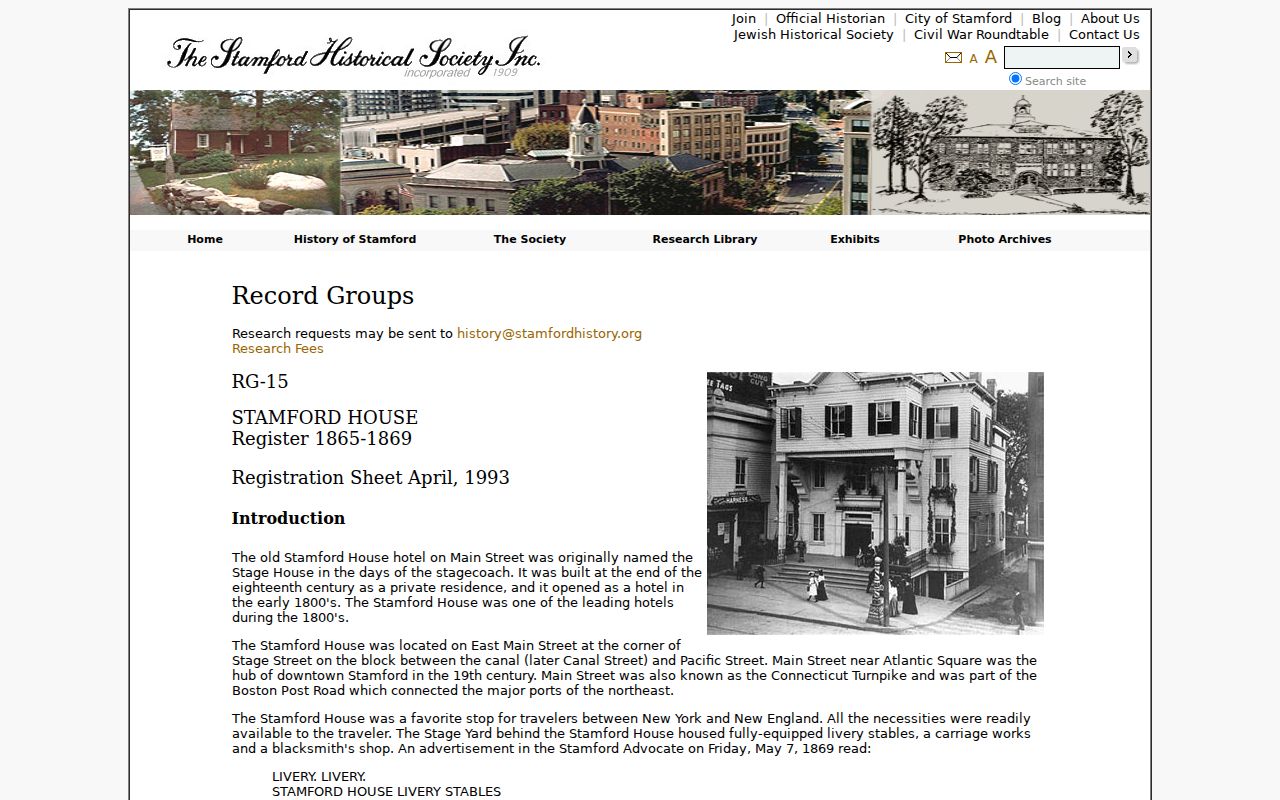
The local record-group listing is useful when an annual run appears in a catalog but no public scan is available.
Ferguson's Stamford City Directory Run
Ferguson confirms a long Stamford city directory microfilm run from 1879 through 1966. Stamford's collection policy also names census microfilm, vital, church, and cemetery records, maps, atlases, yearbooks, photographs, municipal documents, and manuscripts. That mix makes the Stamford Room a practical bridge when a directory shows a name but leaves the next question open.
The Stamford library's online layer includes the Stamford Advocate obituary index, NewsBank Advocate Current and Historical coverage stated as 1829-present, the Advocate Historical Archive stated as 1829-2004, HeritageHub notices, and the Ferguson Digital Archives. Library card or in-library authentication can affect licensed databases. The Stamford directory shelf itself remains a library-access question, not a promise that every reel can be searched from home.
Boyd's Stamford City Directory Pages
Boyd's Fairfield County scan gives Stamford a sharply dated example. The Stamford printed title says “Boyd's General Directory, including Directory of Fairfield County for the years 1881-82,” compiled and published by W. Andrew Boyd and printed in 1881. The Internet Archive item metadata labels the scan 1883. The Stamford section begins at printed page 33, so the page number and title page should travel with any citation.
This is a useful quirk in Stamford research. A Stamford researcher may find “h Main n Meadow,” “h Richmond Hill,” “h do,” or “h 45 Washington av,” not a modern parcel address. Business lines can appear before the residence, and advertisements can interrupt the alphabetical run. The directory can therefore connect a person to an intersection, landmark, widow, boarder, or shop even when a current street search cannot.
Open the digitized Stamford Boyd Fairfield County directory at the archive, then compare the scan with a local shelf or map when an OCR line looks wrong.
The scanned page preserves the printed Stamford section and its period address language, while the catalog discrepancy warns against citing metadata alone.
Marcus Holds Stamford City Directories
The Marcus Research Library at the Stamford History Center is the specialist stop for Stamford directory work. It reports about 7,800 catalogued books, pamphlets, and periodicals, 500 linear feet of boxed manuscripts, 20 completed record groups, 141 inventoried collections, 200 bound manuscripts, maps, atlases, newspapers, vertical files, cemetery inscriptions, and photo archives. Its 1,200-plus vertical files include schools, organizations, government, biographies, transportation, and congregations.
Stamford materials are onsite-only, with research requests and fees described by the center. The listed Stamford reading-room schedule is Thursday and Friday, 11:00-4:00, and Saturday, 10:00-4:00. Contact is 203-329-1183 or history@stamfordhistory.org. The Marcus Research Library page is the place to confirm appointments, finding aids, and access conditions before relying on a Stamford catalog hit.

Marcus adds the archival context that a scan cannot, especially for house surveys, vertical files, maps, and the 1641-1900 land index.
Stamford House Register Before Directories
The Stamford House Register covers 1865-1869, earlier than the verified 1872 Benham title. It sits in the History Center's RG-15 material and can supply names, residences, occupations, and hotel or house context before the later annual directory rhythm. It is best used as a short bridge, not treated as a complete list of everyone in Stamford.
Pair the Stamford register with the History Center's house-record survey holdings for Stamford, North Stamford, pre-1870, Glenbrook, Hubbard Heights, and West Main Street. Ask for the call number and scope, then compare the Stamford address with a directory, deed, or map.
The Stamford house-record collection explains the survey categories and call-number trail.

House records turn a directory name into a place-based research question without assuming that a listed occupant was the legal owner.
Trace a Stamford City Directory Household
A Stamford directory-to-census trace works best when each source answers a different time question. The directory can fill the years between federal schedules; the census can show household members and birthplace fields; deeds and obituaries can explain a move or death. Use the same Stamford street spelling and keep the original page citation.
- Choose the Stamford person's surname, likely street, and one directory year. Read the abbreviation key before copying the address.
- Check nearby years and every person at the address, including a spouse, widow, boarder, adult child, or business partner.
- Pair the entries with the 1880, 1900, 1910, 1920, 1930, 1940, and 1950 federal censuses. The 1890 census is a known national loss.
- Use the Stamford Lost Streets exhibit and Sanborn maps when Meadow/Hawthorne, School/Tresser, St John's Place, Holly, Cottage, Chapel, or Willow forms do not match.
- Close the Stamford trail with the Ferguson obituary index, church or vital record route, probate file, and deed index, marking which source is a lead rather than proof.
The National Archives census release guidance explains the 72-year rule and the household schedule context. When a historical entry needs a current name or record check, use the Stamford resident lookup; present parcel work belongs in the street-by-address path.
Stamford Obituaries Close the Directory Trail
Ferguson's Stamford Advocate obituary index begins in 1830, while the library describes NewsBank Advocate text coverage from 1829 to the present and a historical archive from 1829 through 2004. These notices can connect a directory address to relatives, a former name, a church, an occupation, or an estate. They are published notices, not certified death records.
Search the Stamford name, then try the street, spouse, initials, and neighborhood. A Stamford notice can explain why a person vanishes from an annual run, but it may use a former address or shortened name. For a certified death copy, use Stamford Vital Records; for an estate link, use the Probate District.
Ferguson's Stamford newspaper obituary index is a local bridge between the printed directory and later family-history records.
Census Checkpoints for Stamford Directories
Federal census schedules are decennial, while a Stamford city directory can be annual or irregular. Compare the Stamford directory before and after a census year instead of treating a single entry as a full residence history. FamilySearch and the Connecticut State Library add church, birth, deed, and town-record routes, but access can require an account, an affiliate library, or an onsite visit.
- 1865-1869: Use the Stamford House Register for an early household and house context.
- 1872: Check Benham's verified Directory of the Town of Stamford against the local bibliography.
- 1879-1916: Use the History Center run and Ferguson microfilm around the 1880, 1900, and 1910 census years.
- 1881-82: Use Boyd's printed page 33 Stamford section, preserving its title and catalog-date discrepancy.
- 1920-1950: Pair later directory or microfilm entries with released NARA schedules, then verify a move with a deed, notice, or house file.
The 1890 national census loss is not a Stamford-specific gap. The State Library's History and Genealogy guides and FamilySearch's Connecticut collections are the documented fallback for earlier names, while local shelves remain essential for directory years that were never digitized.
Digital Stamford Directory Access
Stamford online pages and onsite shelves serve different needs. The Boyd scan is free, but its title and item metadata differ. Ferguson's archive, library microfilm, Marcus manuscripts, and FamilySearch images each have different catalog, login, or onsite limits.
The Ferguson Digital Archive host is the online entry point. The Stamford research capture could not render its live archive because of a robots restriction, so confirm the current search and image controls directly. Keep the Stamford source name, collection, year, page, and access date in notes. Those details make a digital directory useful even when a scan is later moved.
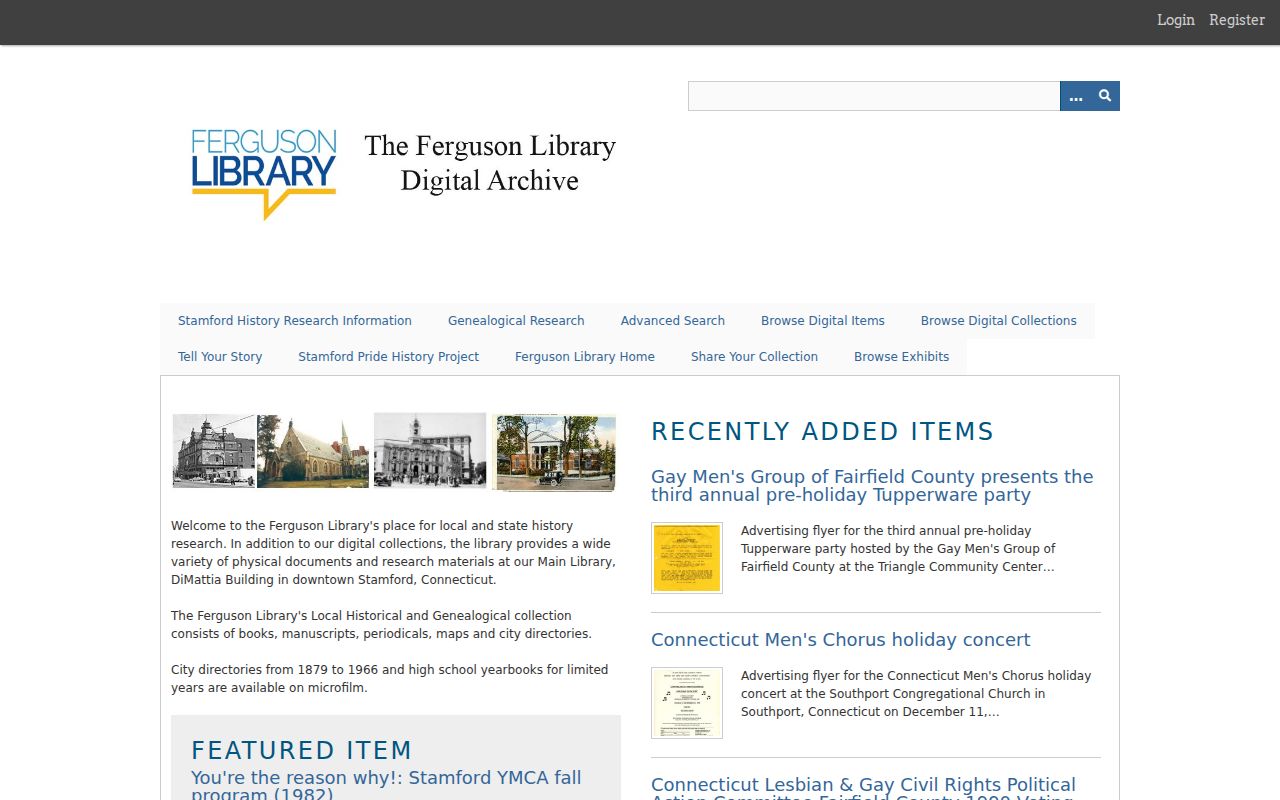
The Stamford archive image belongs beside the physical shelf, not in place of it. A failed online search should lead to Ferguson, Marcus, the State Library, or a focused Stamford record request.
Access check. A Stamford online scan can show a page, while the local library or History Center can explain its title, missing years, map references, and related files.